
MEHRAN UNIVERSITY
OF
ENGINEERING AND TECHNOLOGY
Regulations (Revised) regarding the General Scheme of Studies for the Bachelor’s Degree Programs (including B.E, B.Arch., B.CRP, B.E Tech, BS, and BBA) of the Mehran University of Engineering and Technology, under Section 47(1) (n) of the Act 1977.
- Short Title. These Regulations may be called the Mehran University of Engineering and Technology Bachelor of Degree Courses Regulations 2025.
- These Regulations shall be subject to the Mehran University of Engineering and Technology General scheme of Studies for the bachelor’s degree courses Statutes 2012.
- Commencement. These Regulations shall be deemed to have come into force with effect from 25 Batch.
- Definitions. In these Regulations unless otherwise expressly stated, –
- “University” means the Mehran University of Engineering and Technology, Jamshoro.
- “Academic Year” means the Academic Year of the University.
- “Spring / Fall Semester” means a Period of 21 weeks out of an academic year for teaching and evaluation and /or guidance of the students of the University.
- “Summer Semester” means a Period of 08 weeks out of an academic year for teaching and evaluation and /or guidance of the students of the University.
- “Vice-Chancellor”, “Pro Vice Chancellor”, “Dean”, “Director”, “Chairman / Chairperson” “Teacher” and “Controller of Examinations” means respectively the Vice-Chancellor, the Pro Vice Chancellor, the Dean of Faculty, the Director of Institute, the Chairman/Chairperson of Teaching Department, the Teacher and the Controller of Examinations of the University.
- “Departmental Committee”. Each Department/ Institute will have a Departmental Committee consisting of three seniors most teachers of the Department/Institute including Chairman/ Chairperson/ Director as convener.
- “Credit Hours (C.H.)” have been defined in section 6.
- “Quality Point (Q.P.), Grade Point Average (G.P.A.), and “Cumulative Grade Point Average (C.G.P.A.) has been defined in section 17.
————————————————————————————————————————————————————–
Approved by Academic Council in its 110th meeting held on 9th April 2025 vide resolution 110.1a and approved by the Syndicate in its — meeting held on ———, vide Resolution No. ——-.
- Undergraduate Structure of the bachelor’s degree Programs including B.E, B.Arch., B.CRP, B.E Tech, BS, and BBA is given below Table 5.1
Table 5.1: Undergraduate Structure of bachelor’s degree Course
| Degree Programs | ||
| 04 Year | 05 Year | |
| Total No. of Credit Hours (Minimum)* | 134 | 172 |
| Total No. of Credit Hours (Maximum)* | 140 | 188 |
| Semester Duration | Minimum of 16 weeks of teaching excluding examinations | |
| Course Duration** | Minimum of 8 semesters Maximum time limit of 6 years, further extendable for one year with the approval of Statutory Bodies | Minimum of 10 semesters Maximum time limit of 7 years, further extendable for one year with the approval of Statutory Bodies |
| Summer Session | For deficiency / failure, repetition of courses up to 9 credit hours (08 Weeks duration) | |
| Course Load per Fall / Spring Semester for Regular Full -Time Students | 15-18 Credit Hours (In special cases 15 –19 Credit Hours) | |
* Subjected to meeting the requirements of the respective Accreditation Councils.
**A student must complete the degree course within the allowable degree course duration i.e. 06 years for 04-year degree program and 07 years for 05-year degree program. In cases of valid reasons, the duration of study for any university program may be extended by one additional year (two semesters). Request for extension in duration of study can only be made after 06 years of study for 04-year degree program/ after 07 years of study for 05-year degree program. Students who do not complete their studies within the specified period, including the extension, shall be removed from the university rolls. Students granted an extension shall be required to pay the full admission fee.
- Credit hours for undergraduate degrees
6.1 A credit hour means teaching/learning a theory course for one hour each week throughout the semester.
6.2 One credit hour in laboratory or practical work/project would require lab contact of three hours per week throughout the semester.
6.3 The credit hours are denoted by two digits within brackets with a plus in between. The first digit represents the theory part while the second (right side) digit represents the practical. Below Table 6.1 gives the possible distribution of Theory and Practical Credit hours.
Table 6.1 Distribution of Theory and Practical Credit Hours
| Credit Hours | Distribution in Theory and Practical Hours |
| 01 | (1+0) / (0+1) |
| 02 | (2+0) / (0 + 2) |
| 03 | (3+0) / (2 + 1) / (0 + 3) |
| 04 | (3+1) / (0 + 4) |
7.0 Course layout for undergraduate students
7.1 4 year undergraduate degree programs are composed of 134-140 Credit Hours in which 134 represents the minimum and 140 represents the maximum credit hours required to be completed, subject to meeting the requirements of the respective Accreditation Councils.
7.2 5 year undergraduate degree program (Bachelor of Architecture) is composed of 172-
188 Credit Hours in which 172 represents the minimum and 188 represents the maximum credit hours required to be completed, subject to meeting the requirements of the respective Accreditation Councils.
7.3 Undergraduate curriculum structure
- For Engineering programs: The courses for the Engineering programs will consist of minimum 134 credit hours out of which:
- a minimum of 72 credit hours of engineering domain
- a minimum of 42 credit hours of non-engineering domain
- FYDP Project=06 Credit Hours
- Multi-Disciplinary Engineering Courses = Min. 06 Credit Hours
- 08-14 Credit Hours (Flexible Engineering / Non-Engineering Courses) may be adjusted as per requirements.
The above distribution is subject to the requirements of respective Accreditation Councils. Table 7.1 shows the course structure for the engineering programs.
Table 7.1: Course Structure of Engineering Programs (In line with PEC Framework and HEC UG Education Policy-2023)
| Knowledge Profile (WK-1 to WK-8) | Knowledge Area | Sub-Area | Courses | Credit Hours |
| Non-Engineering Domain | ||||
| WK-2 | Natural Science | Math | Quantitative Reasoning-I (or equivalent courses for all Engineering Discipline) | 3 |
| Quantitative Reasoning-II (or equivalent courses for all Engineering Discipline) | 3 | |||
| WK-1 | Advanced Applied Math Courses (as per requirement of the Engineering Discipline) | 6-9 | ||
| Natural Science (Physics, Chemistry, Math) | Applied Physics | 3-9 | ||
| Applied Chemistry | ||||
| Math Electives | ||||
| WK-7 | Humanities | English | Functional English | 3 |
| Expository Writing | 3 | |||
| Culture/ Study of Religion | Islamic Studies OR Religious Education/Ethics | 2 | ||
| Understanding of Holy Quran – I&II (Fehm-e-Quran I & II) | 2 | |||
| Ideology and Constitution of Pakistan | 2 | |||
| Pakistan Studies | 2 | |||
| Arts & Humanities (Languages of study of religion) | 2 | |||
| Social Sciences | Social Sciences | 2 | ||
| Application of ICT | 5 | |||
| Civics and Community Engagement | ||||
| Management Sciences | Professional Practice | Project Management | 2 | |
| Entrepreneurship | 2 | |||
| Total (Non-Engineering) | Min 42 | |||
| Engineering Domain | ||||
| WK-2/ WK-4/ WK-5/ WK-6/ | Computer and Information Science | AI / Data Science / Cyber Security | 6-9 | |
| WK-3/ WK-2/ | Foundation Engineering Courses | Specific to program objective and outcomes | 22 – 24 | |
| WK-4/ WK-2/ WK-1/ | Core Breadth of Engineering discipline | Specific to program objectives and outcomes | 22 – 24 | |
| WK-5/ WK-6/ | Core Depth of Engineering Discipline | Specific to program objectives and outcomes | 22 – 24 | |
| Min 72 | ||||
| WK-2/ WK-4/ WK-5/ WK-6/ | Multidisciplinary Engineering courses | Specific to program objectives and outcomes | 6 | |
| Occupational Health and Safety (mandatory-01 CH) | ||||
| WK-6/ WK-8/ WK-7/ | Final Year Design Project (FYDP)/ Capstone | Design Project (FYDP)/ Capstone | 6 | |
| WK-6/ WK-7/ | Industrial Training | Internship (06-08 Weeks) | Mandatory & qualifying | |
| WK-4/ WK-5/ WK-6/ WK-7/ WK-8/ WK-2 | Innovative and Critical Thinking (under relevant courses): Complex problem solvingComplex Engineering ActivitiesSemester ProjectCase StudiesOpen ended labsProblem Based Learning (PBL) | |||
| Total (Engineering Domain) | Min 84 | |||
| Flexible Engineering/ Non-Engineering Courses may be adjusted as per the requirement | 8-14 | |||
| Total Credit Hours | 134-140 | |||
ii. For Computer Science programs: The courses for the Computer Science program will consist of minimum 130 credit hours, out of which a minimum of 100 credit hours of Computing and Computer Science courses and minimum of 30 credit hours of general and university courses, subject to meeting the requirement of the respective Accreditation Councils.
iii. For Social & Basic Sciences programs: The courses for social and basic sciences disciplines will consist of 60-65% of curriculum towards the discipline specific areas, and 35-40% minor/electives, subject to meeting the requirement of the respective Accreditation Councils.
iv. For Engineering Technology programs: The courses for Engineering Technology programs will be consisting of 70% of curriculum towards the core technology subjects, and 30% of curriculum towards the related subjects, subject to meeting the requirement of the respective Accreditation Councils.
7.4 Final Year Project (FYP) / Thesis / Business Plan: Every student should write a thesis project report /Business Plan in the final year, of 06 credit hours individually or in a group comprises of maximum 03 students, on approved research.
7.5 Internship: Mandatory and qualifying Industrial internship as per requirement of respective accreditation council.
8.1 There will be two regular semesters (Fall, Spring) in an academic year. Following is the breakup:
| i. | Teaching duration of Fall semester | 16 Weeks |
| ii. | Conduct of Mid Semester Exam | 01 Week |
| iii. | Conduct of final Fall Semester Exam | 03 Weeks |
| iv. | Semester Break | 01 Week |
| v. | Teaching duration of Spring Semester | 16 Weeks |
| vi. | Conduct of Mid Semester Exam | 01 Week |
| vii. | Conduct of final Spring Semester Exam | 03 Weeks |
| viii. | Semester Break | 01 Week |
| ix. | Summer Break / Summer Semester | 08 Weeks |
| x | Winter Break | 02 Weeks |
| Total Weeks | 52 |
9 Summer Semester
9.1 Summer semester will be offered as an optional semester of 08 weeks duration. Students will be offered courses to remove deficiencies and can register up to 09 credit hours for summer semester.
9.2 Moreover, a student who has either failed or has been stopped to take the examination due to shortage of class attendance or wishes to improve his/her grade (if obtained ‘C’ Grade or below) is allowed to register in summer semester.
9.3 The contact hours per week during the Summer Semester will be doubled to ensure that the course is completely taught in a summer session with half of the duration as compared to a regular (Fall/Spring) semester.
9.4 All the qualifying rules for Fall / Spring semester will be applicable to summer semester.
9.5 There will be no supplementary / special examination after the adoption of summer semester.
9.6 The course in Summer Semester will be offered with the minimum course registration of 05 students (where intake of students is small, minimum course registration should be 50 % failure students)
10.1 The calendar will include the following information: to be adopted from next academic year.
- Date of start of classes
- Conduct of mid semester
- Date of suspension of classes
- Conduct of final semester exam
- Announcement of results
- Semester Break
The academic calendar will be prepared for Fall Semester and Spring Semester of each academic year.
10.2 In case a university is closed due to unusual circumstances, then makeup classes may be arranged on weekends or in evening time to cover the lapsed period of the students.
11 Withdrawal of Courses from Fall / Spring Semester
11.1 Students may be allowed to withdraw from a course during first 6 week of the semester. In such a case the transcript shall record that the student enrolled in the course and withdrew. Consequently, grade W will be awarded to the student which shall have no impact on the calculation of the CGPA of the student.
11.2 A student withdrawing after the 6th week shall be automatically awarded “F” grade which shall count in the GPA and stay on the transcript.
12 Repeating courses / improvement of CGPA
12.1 If a student gets ‘F’ grade, she/he will be required to repeat the course. However, “F” grade obtained earlier will also be recorded on the transcript.
12.2 Undergraduate students may be allowed to repeat a course in which she/he has obtained grade “C” or below. In such a case both the previous and new grade obtained will be recorded on the transcript, however, only the better grade shall be used in the calculation of CGPA.
12.3 In case of CGPA improvement, it would be recorded with (Imp) on the transcript.
13 Attendance
Minimum 75 % attendance in a course is required to appear in the examination of that course. (Condonation may be limited to 70%)
14 Examination
14.1 In each semester, students may be required to appear in quizzes, tests, mid semester, final semester examinations, presentations (individual/group), group discussion, and submit projects/assignments/lab reports etc. These assessment marks (to be determined by the teacher concerned) may have different weightage contributing towards the overall assessment in percent marks. This weightage may be determined on the basis of following table:
| THEORY | ||||
| Theory of Maximum 100 marks | Theory of Maximum 50 marks | |||
| i. | Quizzes / Test(s) | 15 | 07 | |
| ii. | Assignments/ Project / Presentation | 15 | 08 | |
| iii. | Mid Semester Exam | 30 | 15 | |
| iv. | Final Examination* | 40 | 20 | |
| PRACTICAL | ||||
| All Departments | Subjects having Course Code of Architecture Department | |||
| i. | Guided Lab | 30% | 30% | |
| ii. | Open Ended Lab / Mini Project / PBL | 20% | 20% | |
| iii. | Final Exam; Objective Test | 30% | 20% | |
| iv. | Final Exam; (Conduct of Practical / Viva Voce / Jury)* | 20% | 30% | |
*Appearance in Final Exam; (Conduct of Practical / Viva Voce / Jury) is mandatory
FINAL YEAR PROJECT / THESIS / BUSINESS PLAN
All Departments (except Architecture and City & Regional Planning)
| Semester | Thesis CH | Thesis Credit marks | Maximum Sessional Marks (By Supervisor) | Maximum Marks for Thesis Viva Voce / Exam | ||
| Internal | External | Chairman | ||||
| 7th | 3 | 100 | 25 | 25 | 25 | 25 |
| 8th | 3 | 100 | 25 | 25 | 25 | 25 |
Department: City & Regional Planning
| Semester | Thesis CH | Thesis Credit marks | Maximum Sessional Marks (By Supervisor) | Maximum Marks for Thesis Viva voce/Exam/ | ||
| Internal | External | Chairman | ||||
| 7th | 3 | 100 | 25 | 15 | 45 | 15 |
| 8th | 3 | 100 | 25 | 15 | 45 | 15 |
Department: Architecture
| Semester | Thesis CH | Marks | Maximum Sessional Marks (By Supervisor) | Maximum Marks for Thesis Viva voce/Exam / Jury | ||
| Internal | External | Chairman | ||||
| 9th | 5 | 250 | 50 | 40 | 120 | 40 |
| 10th | 10 | 500 | 100 | 80 | 240 | 80 |
14.2 In the beginning of a semester, the Instructor of each course should hand out a syllabus
providing information to the students about assessment criteria, paper specification, schedule of material to be taught (TTP and Lesson Plan), take home assignment policy, recommended reading materials and any other information important for the successful completion of the course and its requirements.
14.3 To implement semester system effectively the subject teacher must display his/her provisional result within five days after the conduct of Mid and Final exam of that subject and submit the same to the Controller of Examination for final announcement. Mid exam copies/Assignments/Class test(s) are to be shared with the students after the assessment.
14.4 Expert / External examiner will be called only for Final Year Project/ Thesis / Business Plan Examination.
15 Grade Equivalent
| GRADE | GRADE POINT | PERCENTAGE OF MARKS |
| THEORY / PRACTICAL / PROJECT | ||
| A+ | 4.0 | ≥ 90% |
| A | 3.5 | 81% – 89% |
| B+ | 3.0 | 73% – 80% |
| B | 2.5 | 65% – 72% |
| C+ | 2.0 | 60% – 64% |
| C | 1.5 | 55%- 59% |
| C- | 1.0 | 50% – 54% |
| F | 0.0 | < 50% |
| W* | N/A | N/A |
| I** | N/A | N/A |
* Withdrawn
** Incomplete
Note: The results will be prepared on the basis of Grade Point Average (G.P.A). Fraction is to be considered as a whole number.
16 Computation of semester grade point average (GPA) and cumulative grade point average (CGPA)
GPA:
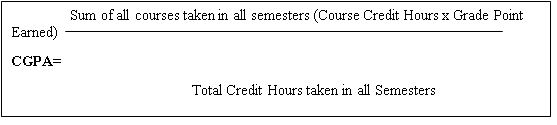
This is a figure ranging preferably from 0.00 to 4.00 be used to indicate the performance of a student in the semester concerned. A standard scale of 0.00 to 4.00 is adopted.

Semester Grade Point Average (GPA) and Cumulative Grade Point Averages (CGPAs) will be calculated using following relationship:
17 CGPA required for the completion of undergraduate
17.1 For completion of the degree, the minimum qualifying CGPA for all Bachelor’s Degree Programs is 2.00.
17.2 In case a student secures less than 2.00 CGPA (minimum qualifying CGPA) after the last Semester of the degree program, she/he may be allowed to get re-admission in one or more courses, in which his/her Grade is C or below, provided that she/he is not debarred under the time duration specified for the program (as defined in Table 5.1). The readmission will be allowed after the payment of full admission fee.
17.3 A student, securing 2.00 or higher CGPA, after the last semester of the degree program may be allowed to improve one or more courses, in which his/her Grade is C or below, provided that she/he is not debarred under the time duration specified for the program (as defined in Table 5.1); she/he may be allowed to get re-admission in that course(s). The readmission will be allowed after the payment of full admission fee. A student can opt this option only if pass certificate, transcript and degree certificate are not issued in his/her favour.
18 Transfer of credit hours for undergraduates
18.1 Credits are transferred on course-to-course basis i.e. a person taking course A at University X is allowed to transfer his/her credits to University Y provided that course A is equivalent to course B taught at the Y University.
18.2 No credit hour of a course will be transferred if the grade is less than C for undergraduate.
18.3 The transfer of credit hours should not be more than 50% of the total credit hours required for the degree.
18.4 Credit hours may only be transferred between duly recognized HEIs and Internationally recognized Universities.
19 Format of final transcript
The final transcript for the award of degree includes following information:
Front Side:
- Name of Student
- Father’s Name
- Surname/Last Name
- Date of Birth
- Roll No.
- Enrolment No
- Name of the Programme
- Date of Admission / Date of Migration into Degree Program
- Semester Wise Break-up
- Subjects Name along with Credit Hours
- Type of Enrolment – Full Time
- Picture of the Applicant be Printed on Transcript
- Date of Completion of Degree Requirements
- Mode of Study – Regular
- Medium of Instruction- English
- Online Result Verification Key/ID (Front Side at the End of the Transcript)
- GPA/CGPA (at the End of the front side of Transcript)
Back Side:
- Basic Admission Requirement of the Programme
- Previous Degree held by the Student along with Institution Name
- Credit Hours Exempted/Transferred if any/applicable.
- CNIC No. for Pakistani and Passport No. for Foreign Students
- Grading System must be mentioned on Back Side of the Transcript
- Charter Date of the University/DAI may be mentioned
- Name of Campus/College be mentioned along with HEC Permission Date
- Signature of Issuing Officer(s) (Front and Back Side at the end of the Transcript)
- The transcript must have the water-mark seal on it.
- For equivalence of CGPA to percentage, for Transcript purpose only, below Table be placed
| CGPA | 4.00 | 3.5 – 3.99 | 3.0 – 3.49 | 2.5 – 2.99 | 2.0 – 2.49 | 1.0 – 1.99 |
| Equivalent (%) | 95 | 87 | 79 | 70 | 62 | 55 |
20 Departmental committee
Each Department/ Institute will have a Departmental Committee consisting of three senior most teachers of the Department / Institute including Chairman/ Director to assess the progress of the students during the semester and the results of all the examinations including the final semester examination. In case of any discrepancy in the results, during scanning process, the concerned committee will assign a subject expert (other than the Subject teacher) for rechecking the Scripts. The final recommendations of the Departmental Committee concerning the results will be submitted through the concerned Dean and Pro Vice Chancellor / Vice Chancellor for consideration and approval.
- Course file
Maintaining the Course File is compulsory for all faculty members. It should have complete record of every activity that happens during the course. The course file should contain:
(For Theory)
- Academic Calendar
- Course contents with defined CLOs, taxonomy level and linking to PLOs
- Tentative Teaching Plan
- Lesson Plan
- Classes Timetable and student counselling hours including record of makeup classes (if any)
- Semester Progress Report
- Student’s attendance register
- Teaching material
- Class sessional activities and record (Tests/ Assignments / etc. with solutions)
- Mid Semester and Final Exams Question papers and solutions
- Sample of best, worst and average answer sheets of Tests / Assignment / Exams
- Award Lists
- Assessment Sheet conforming to the CLOs and PLOs
- Course Evaluation Report
(For Practical)
- Academic Calendar
- List of Experiments
- Tentative Teaching Plan
- Laboratory Time Table
- Student’s attendance register
- Laboratory Manual / Workbook
- Rubrics Sheet
- Sample of Objective type paper with solution
- Sample of Best, Worst, and average Objective type test
- Award Lists
- Assessment Sheet conforming to the CLOs and PLOs
- Course Evaluation Report
- Freezing of semester
22.1 If a student freezes a semester(s), she/he will resume his/her studies from the same stage where she/he left (froze). No freezing during the semester will be allowed. The maximum duration of the degree program shall remain the same.
22.2 The duration of Freezing is one year; a candidate who gets a semester freeze can get readmission next year with upcoming session.
- Indiscipline in examinations (Unfair Means Cases Committee)
- Any candidate found guilty of following matters; his/her case will be submitted to Unfair Means Cases Committee constituted by the University.
- Removes a leaf from his/her answer book, the answer book shall be cancelled.
- Submits forged or fake documents in connection with the examination.
- Commits impersonation in the examination.
- Copies from any paper book or notes.
- Mutilates the Answer Book.
- Possesses any kind of material, which may be helpful to his/her in the examination.
- Does anything that is immoral or illegal in connection with the examination and which may be helpful to him/her in the examination.
- Refuses to obey the invigilation staff or refuses to follow the instructions issued by the University in connection with the examination.
- Misbehaves or creates any kind of disturbance in or around the examination centre
- Uses abusive or obscene language on the answer script.
- Possesses any kind of weapon in or around examination centre.
- Possesses any kind of electronic device which may be helpful in the examination
His/her case shall result in penalties keeping in view the nature and intensity of offence.
- Cancellation of paper*.
- Suspension from programme for one semester.
- Heavy and light Fine
- Expulsion forever from the University.
- Any other.
- Unfair Means Cases Committee will decide that the student will have to appear in summer semester/with regular semester for the cancelled paper.
24. Appeal against the decision of the Unfair Means cases Committee
If a student is not satisfied with the decision of the Unfair Means Cases Committee, she/he can submit his/her appeal within a week after the decision of the Committee to the Vice Chancellor. No appeal shall lie against the decision of the Syndicate.
- Probation
Probation is a status granted to the student whose academic performance falls below the minimum University standard.
- Students who fail in any course in a semester shall be placed on probation. Additionally, students who pass all their courses but have a GPA below 1.7 out of 4.00 shall also be placed on probation. Such students shall register themselves in summer semester for passing the course/improving their GPA.
- In an academic year [Odd Semester + Even Semester+ Summer Semester] if a student remains on probation for both semesters [Odd + Even], even after attending a Summer Semester of that academic year, he/she shall be removed from the university rolls. However, she/he will be eligible to seek re- admission. Re-admission will be allowed after the payment of full admission fee.
- A student must complete the degree course within the allowable degree course duration i.e. 06 years for 04-year degree program and 07 years for 05-year degree program. In cases of valid reasons, the duration of study for any university program may be extended by one additional year (two semesters). Request for extension in duration of study can only be made after 06 years of study for 04-year degree program/ after 07 years of study for 05-year degree program. Students who do not complete their studies within the specified period, including the extension, shall be removed from the university rolls. Students granted an extension shall be required to pay the full admission fee [Reference Table 5.1].
27 Permission of writer for special students
27.1 A visually impaired student may be allowed to attempt the Mid/Final Examinations of the University on Braille/ Computer/any other means of facilitation.
27.2 In case a student is physically handicapped/visually impaired, she/he may apply to the Chairperson of the respective department (with medical certificate as proof of her/his disability) for permission to engage a writer in Tests/ Examinations of the University two weeks before the start of Tests/ Examinations. She/he will be allowed 45 minutes (maximum) extra time to solve the question paper.
27.3 The qualification of the person who acts as writer of a handicapped student must be at least one step lower than that of the student. (e.g. for level 6 student, the writer should be at the most of level 5).
28 Damaged/lost answer script
In an exceptional case where an answer script is damaged, lost or destroyed due to unavoidable circumstances, then the student may be given the following options:
- Average marks shall be awarded to the student in that subject/course.
- In case of Final Year Examination, if the candidate so desires, she/he shall be given another chance as a special case to take the Examination in that subject/course in the next examination and no examination fee shall be charged from the student.
29 Awards and distinctions
- Medals/Positions will be awarded to the students passing their courses/papers in Semester System in the first attempt only.
- In the Semester System, Letter Grades will be awarded on the basis of GPA / CGPA and Positions would be given on the basis of CGPA. The CGPA calculation will be considered up to four (04) decimal places for the award of Positions. In case two or more students are acquiring same CGPA up to four (04) decimal places, only then the Positions will be shared among those students.
- No medal and position will be granted to candidates who passed the examination in 2nd attempt.
- No medal and position will be granted to candidates who registered himself/herself in summer semester/special semester(s).
- No medal and position will be granted to candidates who completes the degree beyond the minimum prescribed duration.
- No Medal/Roll of Honor will be awarded in the case of improving CGPA.
- The disciplines where number of students is less than 10, no position will be awarded in semester system.
30 Re-admitted Students
These rules & regulations are also applicable to those student(s) who have got re-admission with 25 and onward batch(es).